

The Highs, Demise and New Rise of Gwent: The Witcher Card Game
Hannah Puchelt examines the history of Gwent from Witcher 3 to competitive play through its rise and fall. A part of our otherwise German-language anthology Exploring Card Games.
When Gwent: The Witcher Card Game released as a standalone after the success of the Gwent mini-game in CD Projekt Red’s (CDPR) The Witcher 3, it looked like it might be the new game to watch out for in the world of digital collectible card games (DCCGs). Gwent immediately attracted a dedicated player base thanks to its promising concept with innovative game play mechanics focusing on strategy and bluffing. While many DCCGs like Pokémon Trading Card Game or Magic: The Gathering Arena are based on the ruleset of their analogue counterparts, Gwent followed in the steps of games like Hearthstone by including gameplay elements specific to the virtual space. Like so many other successful DCCGs, Gwent was inevitably dubbed the new “Hearthstone killer” – the game that would push Blizzards Warcraft-based card game Hearthstone off its throne. And with many players switching over to Gwent from Hearthstone, for a while it looked indeed like Gwent was the bright new star in the sky of DCCGs. But after a tumultuous journey with many highs and lows, 2023 was the last year that saw new card additions, active developing and official tournaments for Gwent. As is perhaps already obvious in the “Hearthstone killer” discussion, debating whether a game is alive or dead is a beloved pastime among DCCG communities and so Gwent, the erstwhile Hearthstone killer, was declared dead. Yet, in 2025 servers are still up in running and Gwent does not only have a considerable active player base but is also kept alive by the community itself with an institution called the Balance Council, that implements card changes in a monthly rhythm to keep the game from becoming stale. Even without new card drops or an official e-sports scene, many players still feel a strong emotional bond towards Gwent.
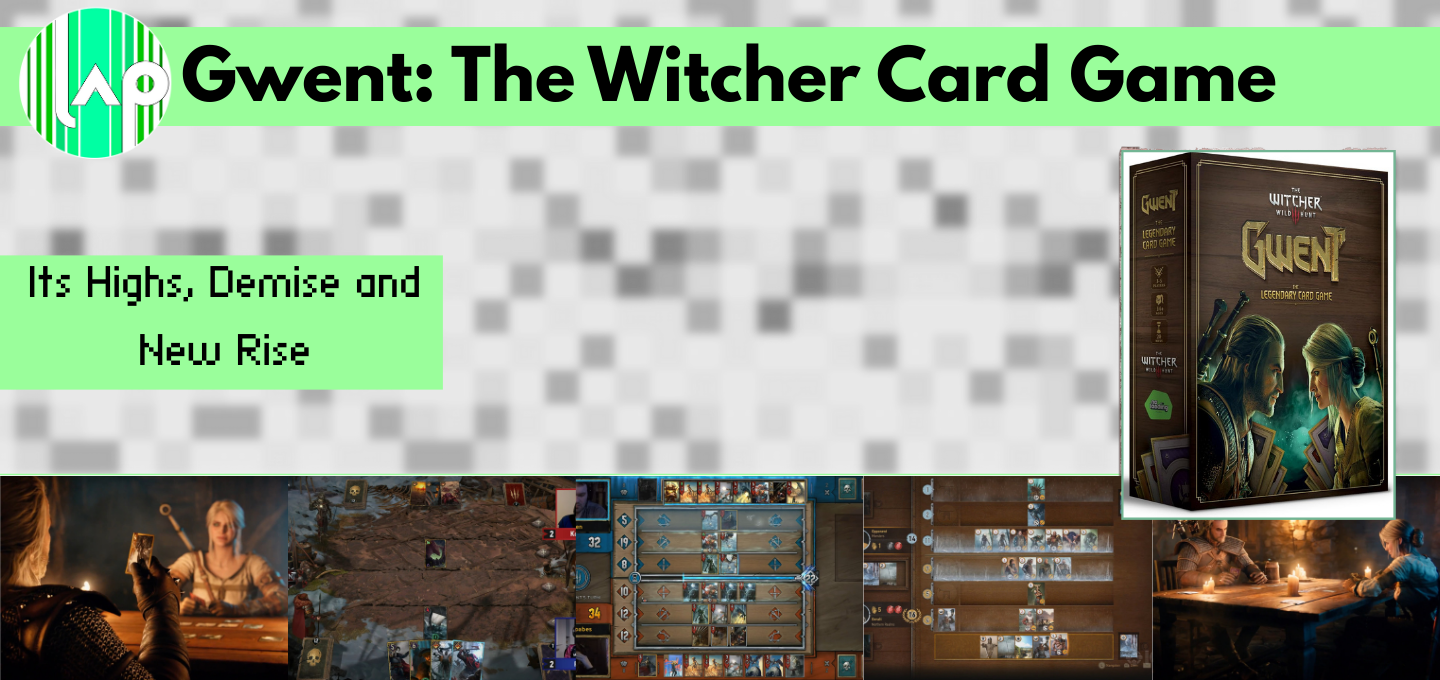
CD Projekt Red et al (see below); Physical Board Game: No Loading Games
As a long-time Gwent player myself, I want to pay tribute to a game that had a big influence on my personal gaming biography and take a closer look at Gwent’s turbulent history in this article. On the one hand, I aim to provide a chronological overview to trace Gwent’s history from its earliest stage as a mini-game to its current state as a community-driven DCCG. On the other hand, as a member of the Gwent community, I want to shine some light on the issues that mattered to the community throughout the years and notably influenced the course of Gwent’s history. With Gwent starting out as a passion project it is not surprising that it attracted a passionate community that significantly shaped the game and felt strongly about questions of monetization, management and scandals within the competitive scene. In this context, I would like to express my heartfelt thanks to some members of the community, who took a deep dive into what went right and wrong with Gwent: Euerfeldi’s video essay A “short” history of Gwent outlines Gwent’s ups and downs throughout the years in a loving yet honest way and was a great aid in structuring this article. Helpful input also came from the [Gwent] The end of an era video, in which Freddy “Freddybabes” Bird provides an insightful perspective on the game’s path as an early professional Gwent player. With that said, let us get into the game!
The (not so) humble beginnings
Gwent has its origins in Andrzej Sapkowski’s The Witcher books (Polish: Wiedźmin). In this series of fantasy novels Gwent (Polish: Gwint) is introduced as a card game, that was especially popular among dwarves and “played noisily and heatedly.” When CDPR first adapted Sapkowski’s novels for their video games The Witcher 1 and The Witcher 2, Gwent did not make an appearance yet. Instead, players could partake in a mini-game called dice poker. But for the third instalment of the series, CDPR developers and card game enthusiasts Damien Monnier and Rafal Jaki decided they wanted to replace dice poker with a card game. The vague description of Gwent in The Witcher books allowed for the creation of a completely new card game, but it took Monnier and Jaki a while to develop a satisfactory concept. During the last days of their deadline, they came up with the idea of a card game in which two armies would clash over the course of several rounds: The idea for Gwent was born. Since the team at CDPR was working to full capacity on the finalization of The Witcher 3, getting their co-workers on board of the Gwent team demanded some craftiness: Monnier and Jaki started playing a prototype version of the game in the company corridor while loudly voicing their enjoyment. Their enthusiasm for Gwent turned out to be infectious: By convincing more and more people to try playing themselves, they managed to get their colleagues excited about the game as well and eventually they had a passionate team, that wanted to ensure the realisation of Gwent. The success soon followed: When The Witcher 3 was released in 2015, the reactions to Gwent turned out extremely positive – so much so, that e-mails asking for a standalone version of the game started flooding the inboxes at CDPR shortly after.
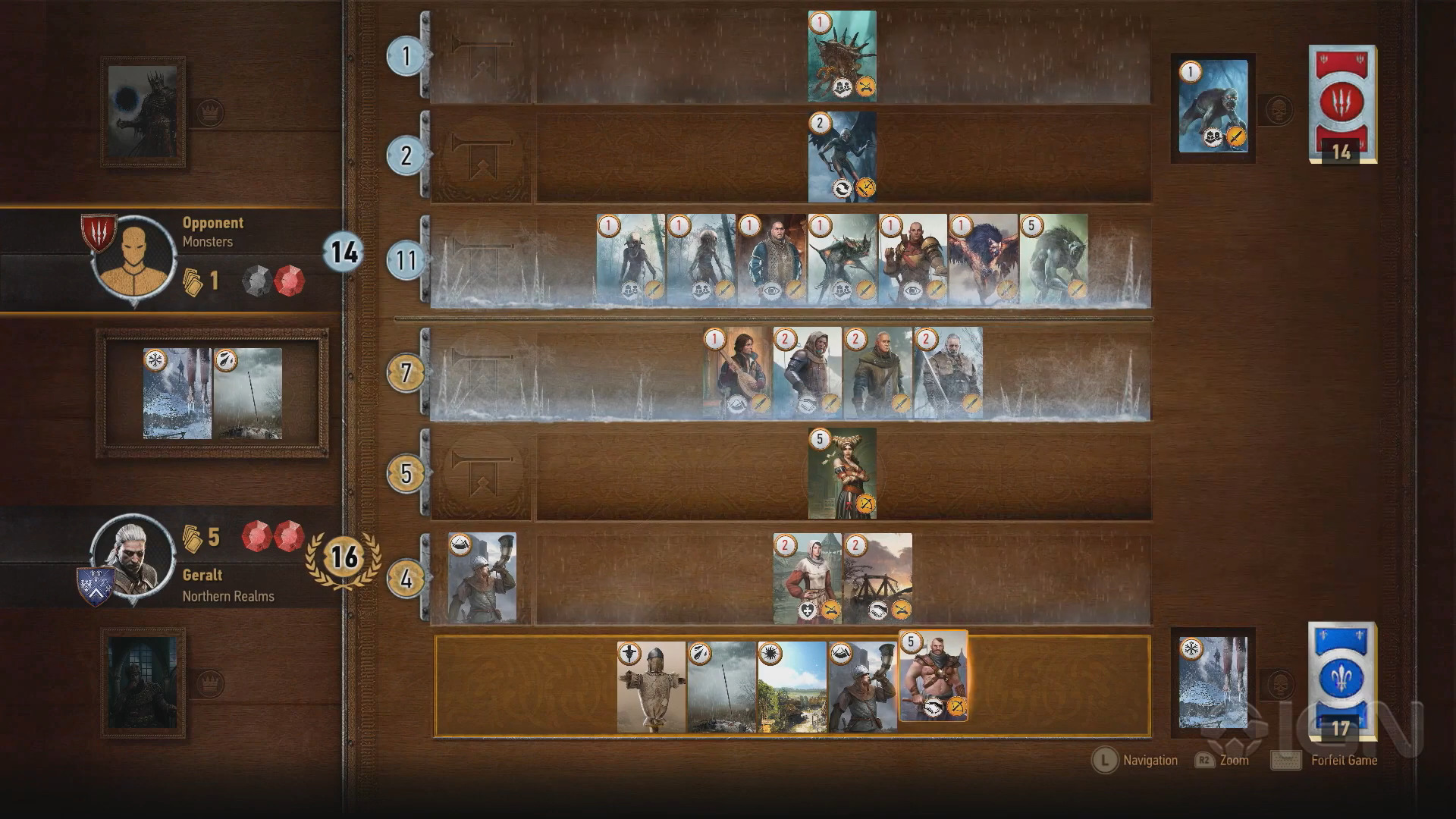
Gwent in The Witcher 3, 2015. Screenshot: Hannah Puchelt.
The huge demand for a standalone version was met with insecurity at first about how to turn The Witcher 3’s Gwent into a properly balanced multiplayer game. According to Monnier, one of the most fun aspects of the game while playing the prototype in person with colleagues was bluffing and trying to outplay your opponent, so that became a focus in the transition from mini-game to multiplayer standalone. During the E3 Expo of 2016, the major video game trade event at that time, CDPR announced Gwent and its closed beta release. The game gained a lot of attention from streamers and gaming news outlets, and registrations for the closed beta surged quickly. To build excitement even further, a first tournament with a prize pool of 100.000 USD (provided by CDPR) got announced for the end of the closed beta phase – anticipation was at an all-time high and many players switched over to Gwent from other card games in hopes of a “potentially revolutionary CCG”, as Freddy puts it.
Gwent’s golden days
The early hype around Gwent raises the question of what made the game so appealing. For players who were introduced to Gwent in The Witcher 3, the setting and rich lore of The Witcher world played an important role. The dark and gritty atmosphere of The Witcher 3 was reflected in Gwent and could not really be found in other card games of that time. The artistic quality of the cards was remarkable in several aspects: Characters of The Witcher world were not only brought to life by high quality illustrations and flavourful card texts but also by professional voice acting. The mechanics differed fundamentally from other games at that time: Gwent had no mana system, the goal of the game lay in accumulating more points than your opponent (instead of killing the opponent’s leader) and the Best-of-Three-rounds winning condition was a novelty in the DCCG world, summarized in Gwent’s infamous tagline: “You may want to lose a battle in order to win the war.” Players could choose from four (later six) factions that provided access to completely different arsenals of cards and abilities which resulted in unique faction and deck identities. One particular appeal for players coming from different card games, especially Hearthstone, was the fact, that randomness (RNG) as a very common factor in many other games was turned down quite far in Gwent. The high emphasis on strategy and bluffing made for a potentially satisfactory experience of being able to play your own deck better than the opponent plays their deck. Another important appeal was the free-to-play (F2P) model of Gwent. While F2P had a rather bad reputation at that time of being a predatory monetization model that incentivised players to spend money for a better chance at winning games, Gwent made a name for itself as a ‘true’ F2P-game. In an interview with PC Gamer, Monnier stated: “The goal for us is that if you feel that you want to spend some money, go ahead, but at no point will the game tell you, this is it, you hit a wall, you must spend money.” Gwent’s monetization model focused on cosmetics and was seen as generous and enabling competitive play without players ever feeling the need to spend money to get an advantage.
The appeal of the game lead to a downright hype around Gwent during the years of 2016 and 2017 – a timeline that can be described as ‘the golden days’ of Gwent. The transition from closed beta to open beta was marked by the first official tournament Gwent Challenger Nr. 1 in May 2017, which paved the way for a buzzing e-sports scene. Gwent not only became popular among players, who were looking for a new card game, it also became increasingly attractive to professional competitive players and content creators as a promising source of income. The second Gwent Challenger tournament in December 2017 ended up as the most watched tournament of Gwent’s history. The big budget event took place in the prestigious historic Moszna Castle in Poland, was hosted by Critical Role legends Matthew Mercer and Marisha Ray and offered a prize pool of 100k USD. The excitement and energy within the Gwent community at that time was palpable: From streams and deck building guides to memes, podcasts and game shows, many content and entertainment formats arose around Gwent. Well-known streamers switched over from other card games and thus gave an additional popularity and PR boost to Gwent; like Miguel “MegaMogwai” Guerrero, a popular Pokemon streamer, who became a caster for several Gwent tournaments; or Adrian “Lifecoach” Koy, who had made a good fortune from winning Hearthstone tournaments and started hosting private Gwent tournaments in his villa in Vienna.
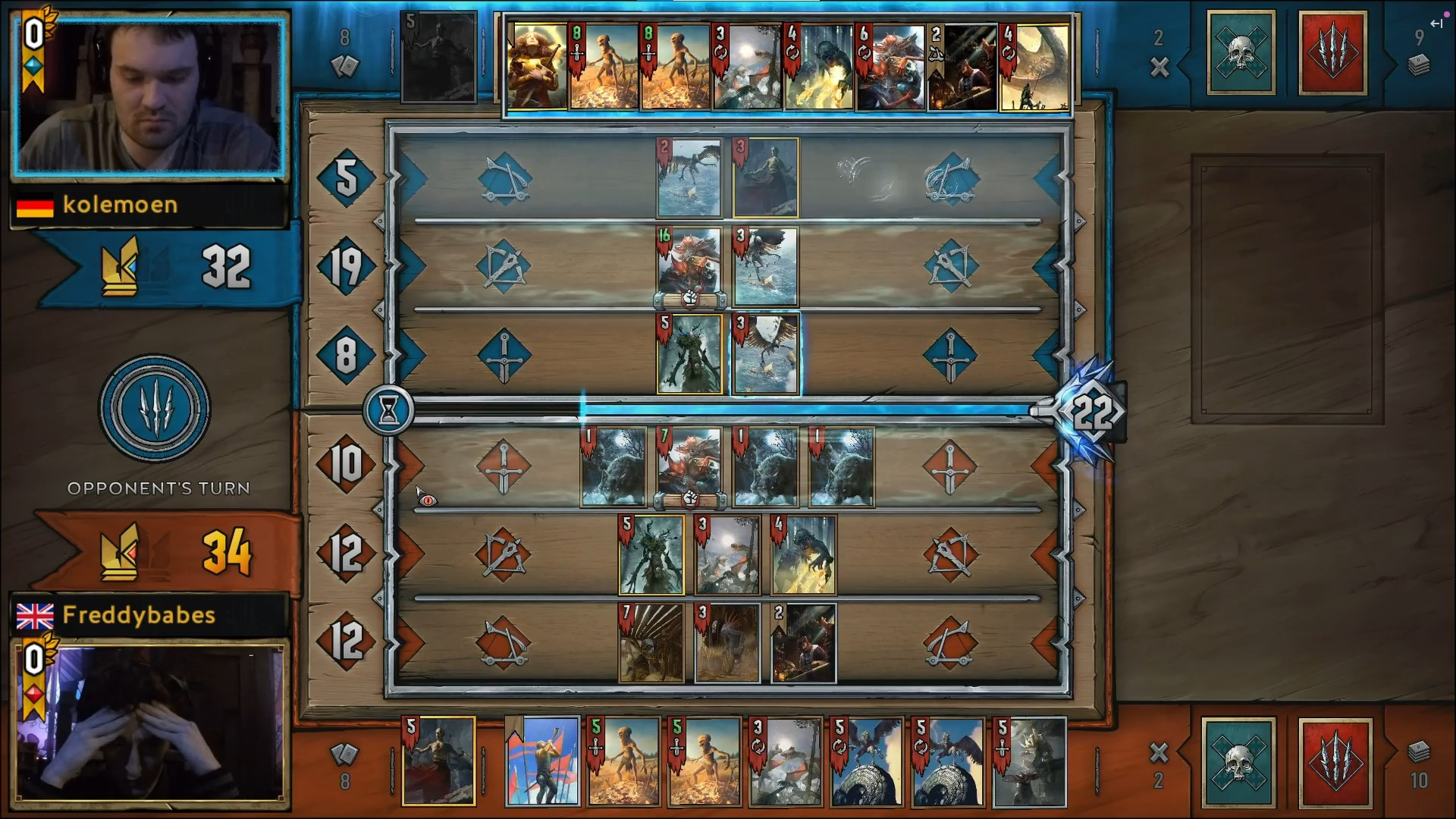
Gwent during open beta: Screenshot from Gwent Challenger Nr. 2 in 2017.
Minor and major setbacks
Unfortunately, Gwent’s golden days did not last forever. According to Freddy, the launch of open beta in May 2017 could already be seen as a first minor setback for the mechanics of Gwent: Fundamental concepts of the game from closed beta got changed and new mechanics allowed for more interaction between decks. More control-oriented decks emerged and influenced the pool of main strategies and popular decks (often referred to as the current meta). Overall, the launch of open beta led to a strong divergence from the much beloved meta of the end of closed beta. But the Midwinter update at the end of the year turned out to be an even more impactful event for Gwent in 2017: This controversial update introduced more than 100 new cards that came with RNG-heavy mechanics and what many players described as ‘dumbed down’ card effects. The update also brought along a number of game-breaking bugs that could not be fixed for a long while because of the release shortly before the holiday season. Midwinter update was met with a huge backlash by the community and players and streamers started leaving the game. Especially the introduction of RNG-mechanics resulted in a growing grievance about the “Hearthstonification” of Gwent. Additionally, a road map published in April 2018 revealed there would be no new card drops in the upcoming six months until the release of Gwent Homecoming in Octobre 2018.
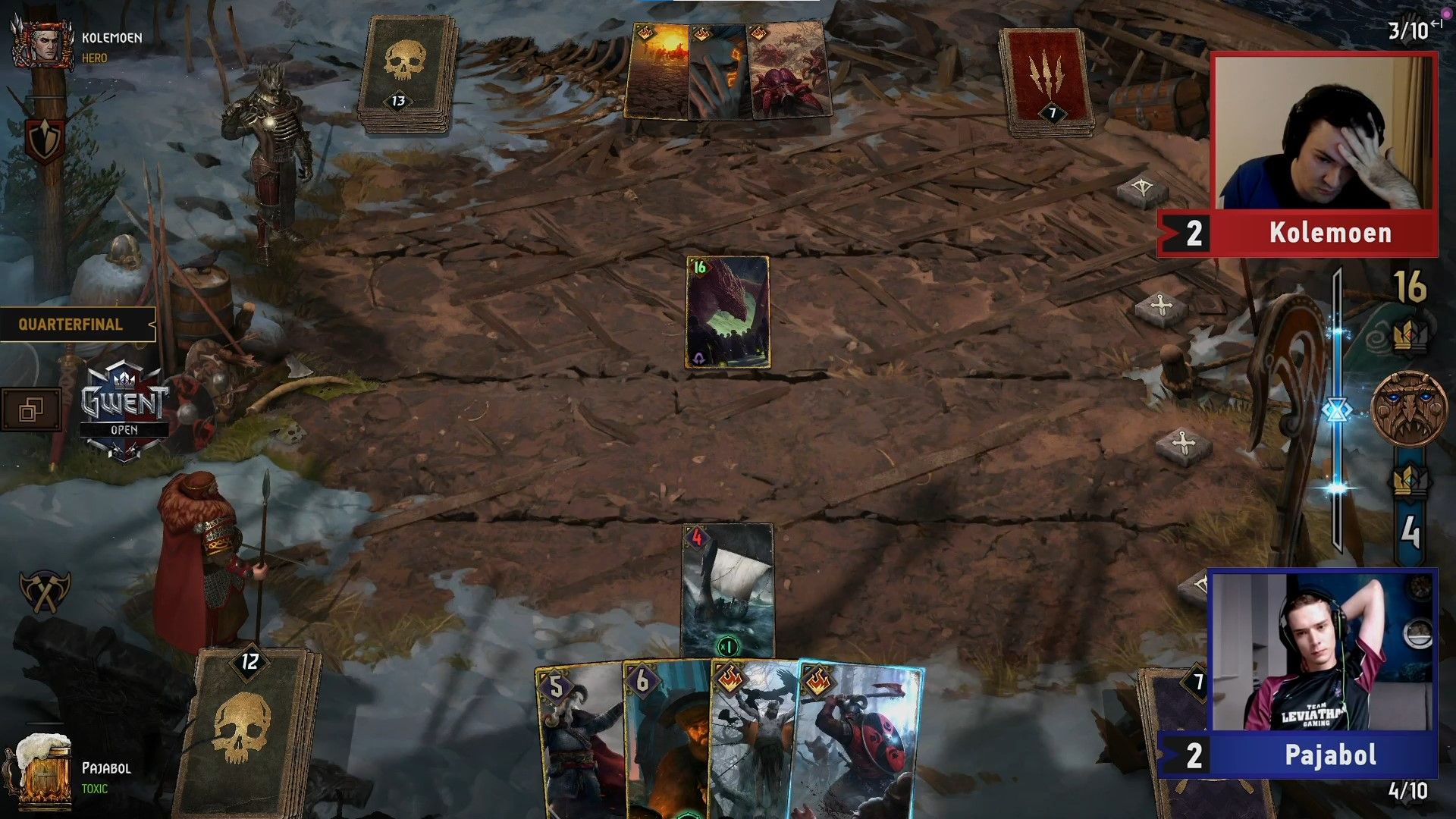
Gwent after Homecoming: Screenshot from Gwent Open Nr. 4 in 2020.
In an open letter to the Gwent community the development team announced Gwent Homecoming as a major rehaul of the game mechanics and visuals. The team emphasised that they were taking criticism from the community seriously: “While fighting with the everyday reality of regular updates and content drops, we lost sight of what was unique and fun about the game. And you played a big role in making us realize that. Thank you for your sincere feedback!” The letter highlighted a focus on the grittiness of the Witcher world, improved visuals and a minimization of RNG-mechanics. Additionally, a single-player campaign called Thronebreaker was scheduled to launch along with Homecoming. Unfortunately, when the Homecoming update finally arrived after the six-month drought without new game content, it turned out to be a disappointment for many players. Despite its name, it introduced what seemed to be a major departure from what many fans knew and loved Gwent for: First of all, the aesthetics and visuals of the game had changed significantly. The game board, that used to be a tavern table, was replaced by a battlefield. The siege row had been discarded, leaving the game with a melee and ranged row to place cards. The leader ability, that had formerly been represented with an illustrated card, would now be activated by interacting with a 3D leader model. The biggest change however concerned card abilities: Many players criticized the removal of fundamental mechanics and the replacement of many creative card abilities from Gwent’s beta by simple boost and damage effects. On top of that, the introduction of the Artifact card type, that could not be interacted with, created a very stale and unenjoyable meta. The first impression of Homecoming was bland and underwhelming for a big part of the player base and resulted in more players and streamers quitting the game. And while Thronebreaker, the other key part of Gwent Homecoming, is most certainly a marvellous game with high quality puzzles, art, music, narration and very positive reviews, it did not meet sales expectations, probably because it was initially only available on CDPRs distribution platform GOG. All in all, Homecoming turned out to be a major setback for Gwent with Jason Slama, one of Gwent’s game directors, calling it “the darkest moment in the project.”
The reasons for this radical move away from a lot of the aspects that made Gwent unique and appealing in the first place can only be speculated upon. It seems plausible, however, that higher ranks at CDPR demanded for the game to be more profitable by making the mobile game market a priority and trying to attract a larger pool of players by bringing Gwent more into line with other DCCGs. As discussed before, Gwent’s F2P-model was quite generous and supposedly did not generate enough profit to justify supporting the game with a sizeable budget. Apart from that, CDPR’s identity lies first and foremost in the development of story-driven role-playing games, so investing resources into Gwent on a larger scale was probably not a matter of great importance for the studio executives.
Yet, with Gwent having started out as a passion project, neither the community nor the development team were ready to fully give up on it. When Slama took over as game director for Gwent in 2019, the team focused on reacting to the criticisms of Homecoming. Bit by bit, many unpopular mechanics were reworked and new innovative cards and abilities added depth to the gameplay again. The quality of the game steadily improved over time. To quote Freddy once again: “It’s honestly impressive how CDPR managed to salvage what was an extremely bare-bones and difficult to enjoy game at the start of Homecoming.” Multiple new expansions were released during 2019 and slowly Gwent decks regained their unique identities and fleshed out archetypes. Despite the constant improvements, it became obvious that the budget got increasingly smaller, especially in the competitive scene.
Gwent’s competitive scene: Pros and Problems
Let’s take a closer look at Gwent e-sports: Gwent laid the foundation for its competitive scene early on with the first Challenger in 2017. Only three months after this first official tournament, Team Aretuza established itself as the first competitive team in Gwent, with team member Benjamin “Kolemoen” Pfannstiel becoming world champion of the first competitive season. In 2018, Team Leviathan Gaming (TLG) followed suit as another major competitive team for Gwent with 3 TLG players winning a World Masters tournament (Aleksander “Pajabol” Owczarek in 2020, Alexander “Cyberz” Schmidt in 2021 and Shunri “Mya-Mon269EX” Miyanoshita in 2023).
I have always wanted to play a game competitively and Gwent was the perfect pick for me because I really enjoyed its core mechanics. The complex nature of Gwent gave me an opportunity to showcase my skills, and over time I kept progressing and achieving better results in tournaments, which was very satisfying. The community has also been a big factor for me as I have met many amazing people from all over the world throughout competing.
– Aleksander “Pajabol” Owczarek, streamer, professional player, winner of World Masters 2
Unfortunately, the majority of Gwent’s competitive history was marked by the corona pandemic: The first World Masters tournament had been planned as a big finale for the first competitive season in Warsaw in March 2020. But due to the pandemic outbreak, the event had to be cancelled 4 days before it was supposed to take place and all following seasons of competitive Gwent were played in online tournaments with much smaller prize pools – the 42.500 USD prize pool of the fifth and last World Masters tournament in 2023 paled in comparison to the prize pools of early competitive Gwent, that had been more than twice as high.
Gwent’s competitive scene was strongly affiliated with the Gwent community in general. Many competitive streamers also streamed on Twitch regularly and many content creators got involved in the competitive environment as casters for tournaments. In this context it is important to me to mention that Gwent and it’s (competitive) community has always been a very male-dominated space, as it is the case for many gaming communities. Being a female Gwent streamer or caster often meant being faced with harassment, having the audience comment more on your looks than on your gameplay or casting and not having your abilities as a player or caster being taken seriously. Calling out sexist behaviour would regularly result in attacks or defensiveness in Twitch chats or Reddit threads. For a more profound discussion about female representation in Gwent I wholeheartedly recommend the Zwei Null podcast episode with Jaggerous, Cecilia “Ceely” Ackermann, Thea “TheaBeasty” Booysen and Kelly “Callonetta”, who share their experiences as female streamers, casters and active community members in Gwent. Nevertheless, the people who would not accept sexist or other discriminatory statements and actively called them out, had a strong presence within Gwent as well and contributed to making the game a welcoming space overall. But unfortunately, sexist tendencies are prevalent in most gaming communities and despite all efforts the Gwent community did not manage to fully shake them off.
Casting Gwent was overall a fantastic experience. I got to meet and work with people from all over the world, and see behind the scenes of an esports production. The most challenging part was remembering to focus on the positive feedback and responses from the community, while setting aside the inevitable few negative comments that have sadly become expected in Twitch and YouTube live chats. I have generally felt that I’ve had to work a bit harder to have my game knowledge be valued and heard by the male-dominated community, despite the hours spent preparing for the various decks and strategies that came with it.
– Cecilia “Ceely” Ackermann, streamer and caster
The competitive Gwent scene also had its fair share of controversies, that lead to a loss of player base over the years: In 2019, professional player Oleksandr “proNEO3001” Shpak was found guilty of violating the competitive ruleset by exploiting a known game bug and receiving forfeits on purpose (also known as ‘win trading’). CDPR therefore disqualified him from competitive Gwent for 12 months, causing an uproar among fellow Ukrainian players. proNEO tried to defend himself by taking a lie detector test, which CDPR did not accept as sufficient proof of his innocence. When the first World Masters tournament for Gwent took place in June 2021 (it had been postponed by 16 months due to the pandemic), one of the qualifiers was Lifecoach, who had already quit Gwent for quite some time. But since his place would have gone to proNEO, whose competitive ban had expired by then, Lifecoach decided to return to the game for the tournament, much to the delight of many early fans. Another case that caused quite a stir in Gwent’s competitive scene was player Li “wangid2021” Nipao losing his place in World Masters 3 because of sanctions imposed due to win trading. Since wangid was one of the most well-known and successful players of the Chinese Gwent community, his disqualification sparked outrage among many players and Gwent lost a fair share of the Chinese player base. Another drop of player numbers happened in 2022: The Russian invasion of Ukraine in February 2022 was met with several global sanctions against Russia. CDPR decided to halt all sales of their games to Russia and Belarus and stated that Russian and Belarusian players would no longer be eligible to compete in official tournaments with prizes provided by CDPR. These announcements were followed by a huge decline in the Russian Gwent player base.
A dead game?
These drops in the player base meant additional setbacks for the game. While the Gwent development team had managed to largely calm the waves caused by Homecoming, the game struggled to gain back its popularity. Many players hoped that a new Gwent single-player campaign, that was confirmed in 2022, would bring a breath of fresh air. This mysterious project had already been teased earlier under the code name “Project Golden Nekker”. But after the announcement, things went quiet around the project at first. And then, suddenly the news dropped in July 2022: Projekt Golden Nekker was a deckbuilding roguelike game called “Rogue Mage” and would in fact release the very next day. Unfortunately, Rogue Mage did not manage to meet the standards that the Thronebreaker single player campaign set in terms of seamlessly blending story, gameplay and deckbuilding. Additionally, many were taken aback by the sudden release with barely any marketing campaigns beforehand. As Euerfeldi puts it eloquently: “Rogue Mage’s release is a surprise to everyone but it’s demise is a surprise to no one.” Much to the chagrin of the community, the new singleplayer game did not turn out to be the anticipated lifesaver for Gwent. Streamers, other content creators and players were moving on to other games and the player base kept shrinking. The resources for Gwent seemed to continuously vanish with fewer and smaller expansions being released. With the discontinuation of the battle-pass-like Journey system on top of that, many players felt like the game was slowly dying after all. Confirmation came in December 2022 during the 4th World Masters tournament: In a developer update CDPR revealed that 2023 would be the last year with new card additions, active developer support and official tournaments for Gwent. As a reaction many content creators announced their departure from the game. Overall, the announcement during World Masters 4 felt like the last nail in Gwent’s coffin and the prevailing tone in the community, especially on social media, was to mourn Gwent as a dead game. A press release announcing layoffs at the Gwent team did not lift the mood either. Even the new card drops of April 2023 were overshadowed by the lingering doom and gloom for Gwent’s future.
Something Ends, Something Begins
But it was apparent that the Gwent team strove to leave the game in a good state before ending developer support: Not only were several completely new cards dropped in 2023, many existing cards, archetypes and abilities also got reworked extensively. “We are planning to close the card pool with every idea that we wanted to add, every mechanic that we want to see, pretty much everything that we would like to see in Gwent”, stated Vladimir Tortsov, who had taken over as game director in 2022. Under the project name “GWENTfinity”, the final phase of active development sought to prepare the game for handing over future balancing control to the Gwent community. In October 2023 the so-called Balance Council system was introduced: Once per month, players who fulfil certain criteria can vote on possible card changes, like power increase or decrease. The idea for the Balance Council was to keep the game from becoming stale and predictable while also ensuring that no chaos ensued from radical changes. In doing so, the Balance Council could even be described as an additional layer to the Gwent gameplay by being another strategy game within the strategy game:
As an influential figure when it comes to voting in the Balance Council, Gwent is now almost like two games for me. One is the normal game and the second is figuring out good BC changes to recommend that can get enough popular votes to go through. Also analyzing and predicting votes coming from other influential coalitions to make sure the overall changes are not too extreme.
– Henry “Shinmiri” Fang, streamer, caster and analyst
With project GWENTfinity and the Balance Council being set in place, 2023 ended with the last Gwent World Masters tournament in December. Many community members travelled to Warsaw to watch what would later be considered one of the best matches in competitive Gwent and Shunri “Mya-Mon269EX” Miyanoshita was crowned the fifth and final Gwent world champion. With many tears shed, trips taken down memory lane and new memories being made during the community meetup for this last official event, Gwent received a proper and bitter sweet send-off.
Now, almost two years after the end of official support and tournaments for Gwent, in defiance of all prophecies of doom, the game seems to be in a solid and enjoyable state with a good deck variety. While there are no official statistics on player numbers, the player base appears active and involved with voting on the monthly Balance Council changes. Shinmiri expresses his contentment with the current state of the game: “The game is still super fun with plenty of active players. I see new/returning players posting on Reddit every day.” Content creators and competitive players still provide the community with regular streams, new deck ideas or season recaps and compete for first place in Pro Rank. And maybe even more importantly: Through all of Gwent’s turbulent history, the community has always been very tight-knit and eager to spend time with each other. Tournament watch parties, discussing all things Gwent, playing games together online and meeting up for weekend hangouts or Gwent (and other) events – the shared passion for this game lead to countless friendships and relationships within the Gwent community, lasting to this day. Gwent started off as a passion project and still lives on because of people’s shared passion for the game. While official development and tournaments may have ended, Gwent itself has not.
The GWENT community showed me what gaming communities are all about. Celebrating a shared passion, forming long lasting bonds and growing together.
– Ryan “RyanGodric” Schou, Community Manager DACH for CDPR
To end on a personal note: Gwent has been a staple in my video game rotation for several years now and I made amazing friends and memories because of it. Even after the end of official developer support, the game still feels very much alive and can claim to have had a lasting influence on many people. At the very least, the existence of this essay speaks volumes about the impact Gwent had on me. And to anyone who might have gotten curious about the game while reading this article: How about a round of Gwent?
About the Author
Hannah Puchelt studied German language and literature with a focus on comparative literature. After completing her master’s degree, she worked in publishing for several years. She currently pursues a PhD in game studies at the University of Innsbruck.
Ludography
Gwent: The Witcher Card Game. 2018. Developer: CD Projekt Red. Publisher: CD Projekt. PC/Android/iOS.
The Witcher 3: Wild Hunt. 2015. Developer: CD Projekt Red. Publisher: CD Projekt. PC/PS 4, 5/Xbox One, X/S/Nintendo Switch.
Bibliography
Competitive ruling: proNEO3001. 2019. Playgwent.com.
https://masters.playgwent.com/en/news/28192/competitive-ruling-proneo3001
Competitive ruling: wangid2021. 2021. Playgwent.com.
https://masters.playgwent.com/en/news/39709/competitive-ruling-wangid2021
Delgado, Manuel. 2022. Marvel Snap and 5 other games supposed to “Kill” Hearthstone. Esports.gg.
https://esports.gg/news/hearthstone/marvel-snap-hearthstone/
Dinsdale, Ryan. 2022. Gwent: The Tumultuous, Untold Story. IGN.
https://www.ign.com/articles/gwent-the-witcher-card-game-tumultuous-untold-story
Fenlon, Wes. 2017. How Gwent became a competitive card game with singleplayer campaigns. PC Gamer.
https://www.pcgamer.com/how-gwent-became-a-competitive-card-game-with-singleplayer-campaigns/
Garcia, Edwin. 2015. Gwent, the card game that almost wasn’t, was born in a bathtub. Nerdist.
https://archive.nerdist.com/gwent-the-card-game-that-almost-wasnt-was-born-in-a-bathtub/
Good, Owen S. 2018. Thronebreaker misses sales expectations because of GOG’s small reach, says CD Projekt Red. Polygon.
https://www.polygon.com/2018/11/17/18100180/thronebreaker-the-witcher-tales-pc-gog-com-steam-cd-projekt-red-sales
Good, Owen S. 2022. Support for Gwent: The Witcher Card Game is coming to an end. Polygon.
https://www.polygon.com/23496337/gwent-shutting-down-support-sunset-witcher-card-game-project-gwentfinity
GWENT HOMECOMING — an Open Letter from Marcin Iwiński and the development team. 2018. Playgwent.com.
https://www.playgwent.com/en/news/18951/gwent-homecoming-see-whats-next-for-gwent
GWENT Masters eligibility criteria change. 2022. Playgwent.com.
https://masters.playgwent.com/en/news/42050/gwent-masters-eligibility-criteria-change
Jaggerous (Host). 2021. #011 – With Ceely, TheaBeasty & Callonetta. In: Zwei Null. The TLG Podcast.
https://open.spotify.com/episode/7iZTCZnMxk7Htdxo3ClVBN?si=a05d4b4630124138
Korshunov, Serhii. 2019. Unfair game: A professional gamer from Ukraine tells of conspiracy in e-sports, litigation with game developers and lie detector tests. Unian. https://www.unian.info/society/10757283-unfair-game-a-professional-gamer-from-ukraine-tells-of-conspiracy-in-e-sports-litigation-with-game-developers-and-lie-detector-tests.html
Macgregor, Jody. 2023. Gwent’s official development ends, leaving future balance patches in the hands of the community. PC Gamer.
https://www.pcgamer.com/gwents-official-development-ends-leaving-future-balance-patches-in-the-hands-of-the-community/
Ohm, Jiwohn. 2023. From Magic to Gwent: Magic’s Impact on the Gaming Industry. In: Beyond the Deck: Critical Essays on Magic: The Gathering and Its Influence. Editors: Shelly Jones, Matthew Wilhelm Kapell. McFarland & Company. P. 273–288.
Sapkowski, Andrzej. 2014. Baptism of Fire. Translated by David French. Orbit.
Switzer, Eric. 2022. Why Did CDPR Release Rogue Mage Like This? TheGamer.
https://www.thegamer.com/gwent-rogue-mage-expansion-cdpr-weird-release/
Tach, Dave. 2016. Gwent is a game born of one wild weekend, busy volunteers and hundreds of emails. Polyogn.
https://www.polygon.com/2016/7/28/12289532/gwent-is-a-game-born-of-one-wild-weekend-busy-volunteers-and-hundreds-of-emails
YouTube
Euerfeldi. 2023. A “short” history of Gwent.
https://www.youtube.com/watch?v=ErTYbw_MmgQ
Freddybabes. 2022. [Gwent] The End Of An Era.
https://www.youtube.com/watch?v=d8NJHQfsMYk
GameSpot. 2018. Why Gwent Almost Didn’t Make It Into The Witcher 3.
https://www.youtube.com/watch?v=QfM9UiQB-ic
IGN Polska. 2016. PAX – Gwent.
https://www.youtube.com/watch?v=h1-e9Sv7VME





2 Kommentare
[…] The Highs, Demise and New Rise of Gwent: The Witcher Card Game Hannah Puchelt examines the history of Gwent from Witcher 3 to competitive play through its rise and fall. […]
[…] Den derzeit einzigen englischsprachigen Artikel unserer Reihe bringt uns Hannah Puchelt: Eine hochspannende Nacherzählung und Analyse von Aufstieg, Fall und Rennaissance des The-Witcher-Kartenspiels Gwent. […]