
Becoming the Enemy (II): A Matter of Perspective in The Last of Us Part II
Who is good, who is evil? Throughout the story of The Last of Us Part II, the player experiences both sides of the antagonistic story between Ellie and Abby.
+++ This article contains major spoilers +++
While my first article focused mainly on ludic and aesthetic features such as the enemy engagement or symbolic similarities, the following analysis’ focal points are affective and motivational core elements of the game. By also considering aspects of my first analysis, I will highlight how emotional features and the protagonists’ motivations, first, make the overall narrative appear coherent. Second, that they are necessary for thrilling turning points, to unfold narrative complexity, and to evoke empathy for both characters which may lead to an inner moral conflict to a player. Third, that their shared core motivation of revenge is, on the one hand, necessary for the plot to develop but, on the other hand, can also be seen as a game-inherent major critique that hate leads to nowhere but doom. By establishing such an emotional bonding not only to the protagonist but also to her antagonist, character behavior, traumatic events, and existential crises become a matter of perspective that make it impossible to distinguish who obtains moral superiority over the other.
The Prologue: Emotional Attachment and Loss
Let us get back to the game’s motivational starting point and to the murder scene of Joel. The player first experiences this tragic scene from Ellie’s perspective, being helplessly fixated at the ground while witnessing Abby beating Joel to death with a golf club. Although this scene stands highly dramatic by itself, it becomes even more emotional when having played the first part of The Last of Us. Having already established a deep bond with both Ellie and Joel by experiencing numerous critical encounters and stirring narrative moments in the first part, Joel’s merciless death effectively becomes personal to the player. This emotional connection and then impact is being intensified (or even enabled) through the prologue. Not only does one have to play with both Joel and Ellie in the beginning of the game, leading to a reduction of ludic and emotional distance between the player and the characters. Also, Joel talks to his brother Tommy about his final slaughterous act in the title’s first part. The player is cinematically being brought back to the climactic ending scene and back to this emotional experience where Joel saved Ellie’s life by killing Abby’s father and many of the Fireflies. Seeing Ellie once again lying unconsciously on the operating table with tubes that are being pulled off by Joel, together with pictures of death and emptiness in the hospital, the prologue sets the emotional tone for the upcoming execution of Joel.

Image 1: Joel rides to the village in the prologue.
© Naughty Dog, 2020/2024/2025
Furthermore, after Joel ends this story, the prologue creates an atmosphere of tranquility and safety. While riding back to the community’s enclave on a horse with the guitar on the back, the player sees images of peaceful nature. Travelling through the woods, the player aims for the direction of the cloudless, bright shining sun while calm acoustic instruments accompany the sounds of the horse’s steps and birdsong. This not only builds a contrast to foregoing flashback’s images of horror and death but also enrolls calmness and temperance that are necessary for the conversation at hand with Ellie.
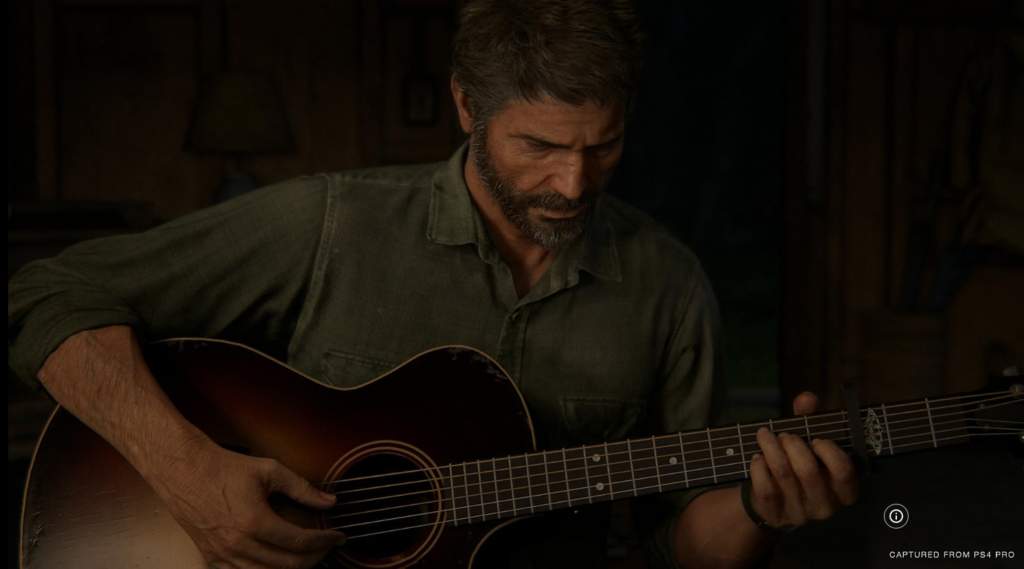
Image 2: Joel plays guitar.
© Naughty Dog, 2020/2024/2025
Their conversation is filled with a type of tension – a friction – between Joel and Ellie that suggests that something has happened between them. Joel’s precautious attempt on engaging Ellie and her rather reserved attitude fill the room with unease. This tense atmosphere is gradually being shifted when Joel starts playing on his guitar and singing along – with the player initiating the song by playing some strings. “If I ever were to lose you, I’d surely lose myself. Everything I have found here, I’ve not found by myself.” The first two sentences embrace what has already been established by highlighting the deep bond between the two and Joel’s feeling of dependence on and love towards Ellie. Their shared past shapes the present of Joel’s life, making him grateful for what he has now thanks to Ellie. The song’s ending – “Our future days, days of you and me.” – closes the circle as it takes up visions of the future again, in which a life without one another appears to be impossible. Linguistically speaking, this is realized by switching the initial deictic center (I; myself) of an uncertain future (if) with the person nearby (you) to a uniting speaker group deixis (Our; of you and me) looking towards a lucid future together as the phrasing leaves no room for uncertainty. As these sensitive words are packed within a song, emotionalized by Joel’s slightly fragile voice and his guitar playing, Ellie’s aloofness breaks and she yields a glimpse of closeness when she holds the guitar that Joel has just given her after he finishes the song. As you readers already know, and thus quite cynically, Joel’s future vision of them both remains unfulfilled on the moment of his death. This in-game disruption makes the interaction between Ellie and Joel and the song even more emotional and intense post-mortem.
Haunting Memories
Due to these initial moments of letting the player get emotionally attached (or reattached) to Joel and the quasi-daughter Ellie, Abby effectively becomes the nemesis when witnessing her act of killing Joel. However, at least for me, this image is being chopped up piece by piece throughout the game, shifting the black-and-white story to a nebulous gray area where neither Ellie nor Abby seem to have the moral upper hand. Despite being a radical and emotive momentum impacting both Ellie and the player, Joel’s violent death appears reasonable through the eyes of Abby. The second protagonist’s story is interspersed with traumatic nightmares, letting her experience the last part’s final scene of seeing her father dead in the hospital room where Ellie should have been examined. She is being haunted by these memories (more on ‘hauntology’ e.g. Fisher, 2012, 2014; Davis, 2005), bringing back her probably most horrible moment in life over and over again. Even in a non-postapocalyptic world, this could lead to desperation and bottled-up hatred. Within a dystopian world where violence and cruelty are daily companions, Abby’s search for revenge appears only consistent. But not only does the background event of her father’s death and its aftermath of haunting nightmares lead to comprehending or even sympathizing with her. Also, her storyline is filled with acts of humanity and relationships that gradually reshape her initial vicious image. This especially comes into place when she meets two fleeing members of the Seraphites. Together, they experience some life-threatening events, save each other several times, and get to know each other on a personal level. Ultimately, by helping Lev and his sister Yara, Abby even finds closure from the haunting death of her father. Later on, Abby develops a deeper connection with Lev – the one of the siblings that survives – and begins to feel responsible for him. Thus, Abby appears not nearly as heartless and evil as she did in the beginning, giving her character more depth and the antagonistic relationship between her and Ellie more complexity and color.
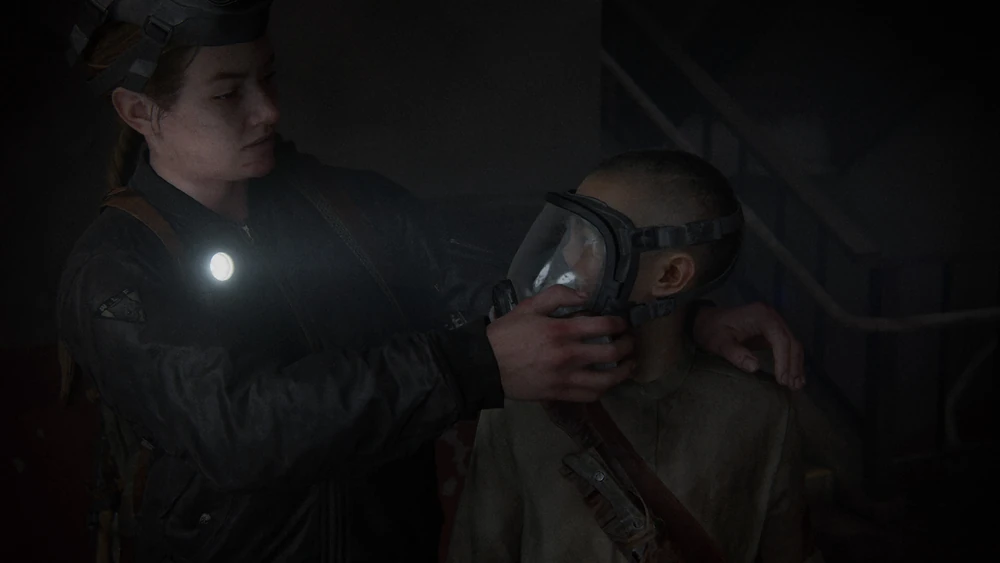
Image 3: Abby gives Lev the gas mask she just found.
© Naughty Dog, 2020/2024/2025
Human Beings
In the end, what the player is being shown is not only a plot full of hate and vengeance but of two (ludic) people who struggle, are physically and emotionally vulnerable, take responsibility, and whose lives are unluckily intertwined. They share grievous losses, traumatic experiences, and deep-rooted pain, but also find love, feel joy in small things, and care for their people or even strangers. During the game, the player gets more and more insights into the protagonists’ own background stories and, also, into their relationships with others. When in a flashback Joel tells Ellie how she – as being the only one known immune person – may have been the source to find a cure for the infection of the spores, the plot hole of the forementioned tension between her and Joel is being cleared up. Ellie figures that her life could have saved countless others if Joel had Jerry let done his examination instead of nearly wiping out the Fireflies. In an altruistic way, this led to Ellie being deeply disappointed in and angry with Joel while at the same time her own vendetta on Joel’s death had caused tremendous deaths – which once again underlines the complexity of the characters, being not black and white but rather exposing imperfectness, that is humanity. Ellie’s affective side also is revealed in her relationship to Dina and moments in which music becomes a motive as she starts playing guitar and singing along – highlighting once again the emotional impact music can have (see e.g. Stöckl, 2016, p. 13 & 16).
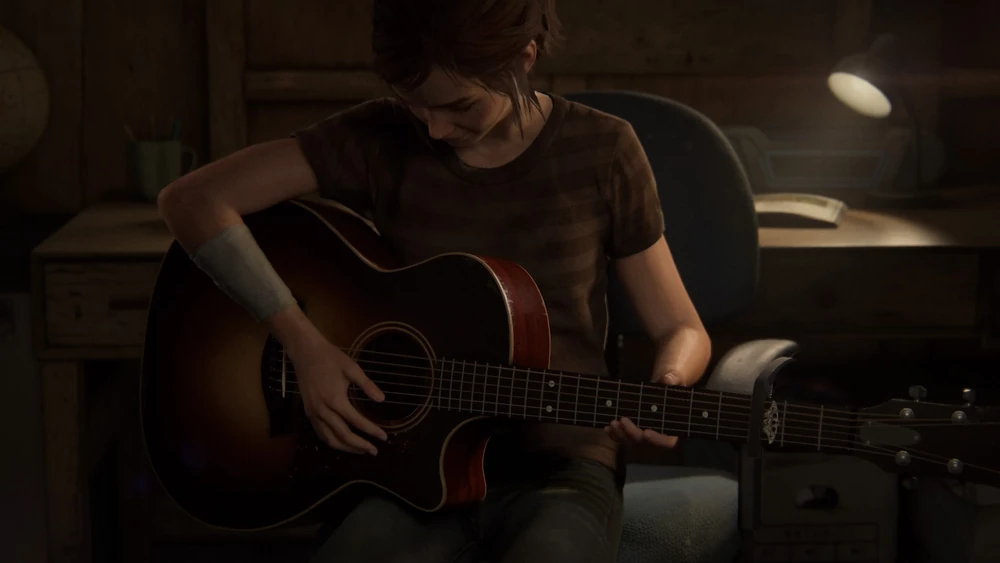
Image 4: Ellie plays guitar.
© Naughty Dog, 2020/2024/2025
When looking at Abby, the first impressions of her being slaughterous and, as of her looks, brawny also undergo changes that lead to more depth of her character. In the mixed-up triangle relationship between her, Owen, and the pregnant Mel, Abby reveals sensitivity and vulnerability. When being saved by the two runaways Yara and Lev, she shows gratitude and, after Yara dies, maybe even a sense of guilt as the young Lev is now being left alone in this hazardous world.
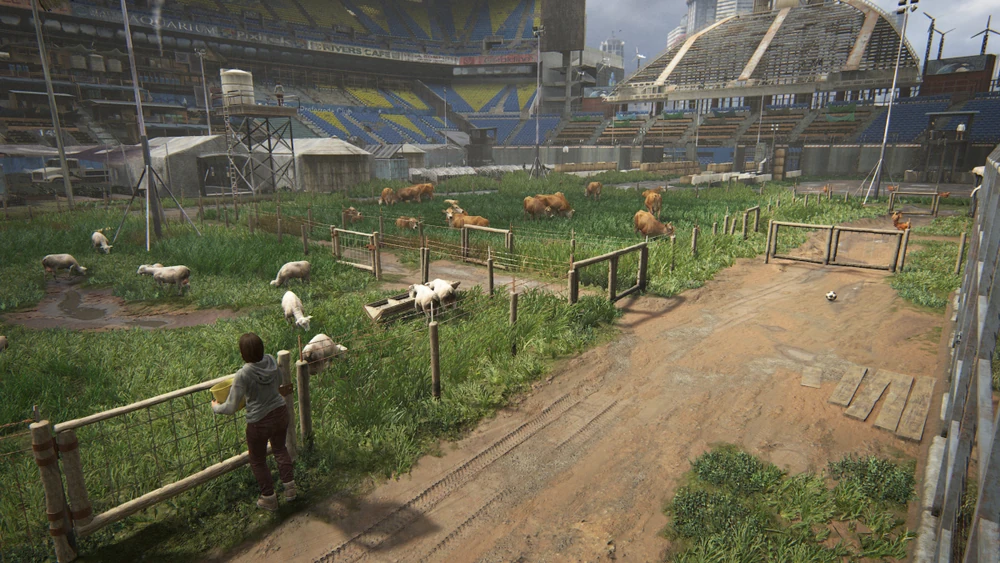
Image 5: The base of the Wolves at the stadium.
© Naughty Dog, 2020/2024/2025
Furthermore, the player gets to know Abby’s community – the Wolves – and how they live. In contrast to their bloodthirsty image created in Ellie’s main part of the game, the Wolves appear as a functioning and caring society. In their headquarters – the stadium –, they practice agriculture and fulfill other communal tasks like educating children, trading, cooking or washing. They have a large and diverse community that acts organized and professional rather than being merciless savages whose only purpose is to kill. Thus, Ellie’s vendetta becomes a vendetta against human beings, against a well-functioning society with sentient individuals. Ellie as well as Abby are both victims and offenders, leading to a highly complex affective attitude towards them as their respective father figures’ deaths initially trigger a series of events.
An Emotional Dilemma
The first experience of Joel’s death through Ellie’s perspective occurs in the present time of the game. The immediacy is striking and intensifies the potential of emotive impact on the player – the focus lies in the here and now rather than on the why of the event. By adding Abby’s preterite perspective later on, this identical act is given another layer, putting the past in the center of attention, that is by focusing on the reasons for this execution. The player is forced to reevaluate the situation and the role of the characters – mainly Joel and Abby – that they played leading to this very situation. Thus, time functions as a central motive and tool of the game, not only to add information to the lore. It also creates closeness to and a better understanding of the protagonists, making them appear more ‘human’ and either taking the player out of the omnipresent cruelty of the world for a few moments or giving insights into their psyche. As their stories continue to intertwine increasingly, their conflict heats up in patches. As described in my first article, the first climax between them occurs mid-game, unsurprisingly, when they encounter each other in the theater. By being forced to fight Ellie with Abby, the player is probably being drawn into a situation that he/she does not want to be in. Fighting Ellie after already having lost Joel and after playing most of Ellie’s storyline appears to be a reluctant act to the player (or at least to me).
The second climactic scene of Elli and Abby’s conflict occurs near the end of the game and inverts the roles. On the coast of the Seraphite’s island during a storm and the invasion of the WLF, the player has to fight Abby with Ellie, cutting and punching her multiple times which almost leads to her death. This displays a major break in expectation since technically, as analyzed in my first article, Abby is the ‘better’ fighter in direct melee combat. Despite Ellie initiating the final fight with a knife, this event’s outcome highlights once again Abby’s vulnerability and intensifies the player’s inner moral conflict.
Meanwhile, Lev – to whom the player also develops a connection – lies nearby in a boat barely alive as Abby wants to escape with him. The player’s emotional dilemma gets nuanced as, beforehand, one rescues both from death by Ellie’s hands as one must free them from being tied to a pole. Despite almost killing Abby afterwards, Ellie just hits a flashback of a positive memory of Joel that leads to sparing Abby’s life. Although open for debate, a reasonable interpretation for her change of mind is the breaking of the ongoing cycle of revenge. If Ellie kills Abby, another person (Lev) losing a parental figure is yet left behind, which may lead to the continuation of the vicious circle of never-ending hate, revenge, and pain. By letting Abby go, Ellie finally breaks this cycle. Although her search for revenge is risky in manners of logical behavior for Ellie’s core motivation, it is an ending that at least to me seems comprehensible and even desirable as through unique narrative moments and playstyles. None of them seems to have any form of moral upper hand, yet both arouse a high level of empathy and compassion. Not having to kill either of them appears to me the most diplomatic and comforting solution regarding the ludic emotional dilemma. As both let go of one another, they overcome the overwhelming power of hate and thirst for revenge and make place for forgiveness or, at least, closure. Thus, they can keep their grip on being human beings. With that, the player – in the role of the executioner – is also not forced to fulfill an act that feels inhumane or immoral. This hypothetical act of injustice even gets exponentiated when considering that the player already killed Abby’s father in the first part, a human being who had the potential of finding a cure for the disease. Killing Abby would mean to become one’s own greatest enemy, incapable of seeing things from a different perspective.
As the player becomes the initial enemy by playing their role, the enemy’s image gradually shifts, making it indistinguishable who really is evil and who is good – making LoU2 a highly affective and narratively complex medium that forces the players to change their perspective and see behind the blending curtain of retribution.
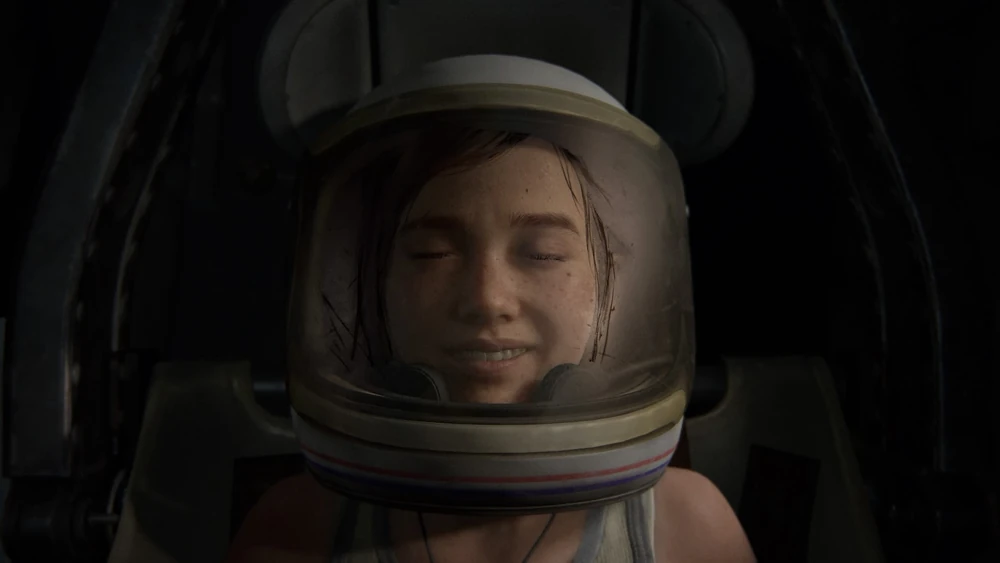
Image 6: Ellie in the space cosmos part of the museum, pretending to journey through space.
© Naughty Dog, 2020/2024/2025
Ludography:
Naughty Dog (2020/2024/2025). The Last of Us Part II. Publisher: Sony Interactive Entertainment, PS4, PS5, PC.
Literature:
Beagan, B., & Saunders, S. D. (2005). Occupations of Masculinity: Producing Gender through what Men Do and don’t Do. Journal of Occupational Science, 12, pp. 161–169.
Cranswick, I., Richardson, D., Littlewood, M. & Tod, D. (2020). “Oh Take Some Man-up Pills”: A Life-History Study of Muscles, Masculinity, and the Threat of Injury. Performance Enhancement & Health, 8. https://doi.org/10.1016/j.peh.2020.100176
Davis, C. (2005). Hauntology, Spectres and Phantoms. French Studies, 59/3, pp. 373–379. https://doi.org/10.1093/fs/kni143
Fisher, M. (2012). What Is Hauntology? Film Quarterly, 66/1, pp. 16–24. https://www.jstor.org/stable/10.1525/fq.2012.66.1.16
(2014). Ghosts Of My Life – Writings on Depression, Hauntology, and Lost Futures. Winchester/Washington: zero books.
Stöckl, H. (2016). Multimodalität – Semiotische und textlinguistische Grundlagen. In Nina-Maria Klug/Hartmut Stöckl (eds.), Handbuch Sprache im multimodalen Kontext (pp. 3–35). Berlin/Boston: De Gruyter (=Handbücher Sprachwissen Band 7).